
INDIAN MUSIC STUDIES
An acclaimed Indian and Jazz Guitarist, Todd Mosby is the only guitarist to become a member of the famed Imdhad Khani Gharana of musicians, India’s most prestigious family of sitar musicians dating back 500 years to Tan-Sen and the Moghul courts.
Encompassing elements from jazz, raag, classical, folk rock and bluegrass into his sound, Mosby has created his own musical syntax. The result is a distinct style unique to Mosby’s sense of composition, transcending known genres of music.
His dedicated 13 year study of classical North Indian music with Ustadt Imrat Khan led a very different guitar technique and the development of acoustic and electric versions of the Imrat guitar, an 18 stringed hybrid sitar-guitar bridge instrument for crossing musical platforms and cultures.
Imrat Khan considers Mosby to be one of the few Western musicians who have mastered the two great mountains of music; North Indian Raag and Western Composition and Improvisation.

I needed to expand the bounds of conventional guitar in order to access the higher sonic aspects of Classical North Indian music… it is in the nature of guitar to allow for these kinds of adaptations… a hybrid sitar guitar to bridge the East West music gap.”
The Imrat Guitar Story
A new branch on the evolutionary tree of stringed instruments
The Imrat guitar is a 20 stringed hybrid sitar guitar designed by sitar maestro Imrat Khan, guitarist Todd Mosby and Luther Kim Schwartz. The instrument is the first of its kind, bridging the cultures of eastern and western music. The use of 12 sympathetic strings, 3 chikara strings, 4 playing strings and javari allow subtle and melodic phrasing characteristic of sitar and modal chordal harmonies found in jazz. The Imrat guitar combines the finest aspects of sitar and guitar.
”It sounds better than a sitar and better than a guitar.” - Usatdt Imrat Khan
History & Development
The Indian sitar is descended from the long-necked Ouds of western Asia and from the Rudra Vina family of Indian musical instruments. When the Persians entered India they brought the Persian oud which eventually and combined with the ancient Indian instrument of Rudra Vina evolving into the Sitar around 1500AD. The Rudra Vina has a long, thin bamboo neck. The strings at the saddle break over a jawari producing a resonance sound similar to the human voice. The neck has fixed frets and is attached by two gourds at either end and is held in an angled up position. There are 4 playing strings, 2 chikari strings and a lower drone string.
The Oud has a short wide neck with elbow bend where the strings are attached and played with a plectrum, and attached to a pear shaped wooden body. Sitar combined the wide neck of oud with the length of the vina, added moveable frets and the javari and attached it a pumpkin gourd. This allowed provided pulling the strings across frets for inflection and combined that with the Vinas, javari, wide neck to get an instrument which was the perfect combination of the two.
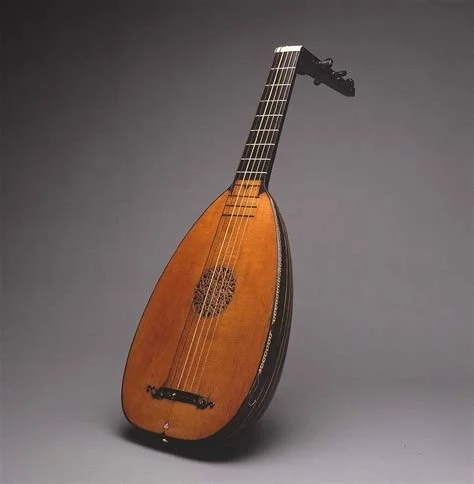
The modern guitar is descended from the Roman cithara brought by the Romans to Hispania around 40 AD, and further adapted and developed with the arrival of the four-string oud, brought by the Moors after their conquest of the Iberian peninsula in the 8th century. Guitar is a combination of Oud which later evolved into Lute and a ukele version of the guitar. The Lute was played originally with a plectrum. As the music became more complicated the fingers were used. It had a fretted short scale wide neck. There were few frets and many strings to give the instrument a range. The neck was then attached to a round wood body. Lute was very popular in its but seemed to lose favor as more strings were added. The ukele was less popular but combined with the lute to become the guitar. The neck was elongated and the body of the uke was made larger. It eventually went from 4 strings to the now standard 6 strings. Scales could be played vertically along with the chords and was played with the fingers. The guitar eventually replaced the Lute by around 1500 AD.
The Imratgitar is a combination of sitar and guitar making it the newest branch on the evolutionary tree of stringed instruments. It incorporates the javari, moveable frets, sympathetic strings, a set of chikara strings and the 6 strings of a regular guitar. It is essentially a sitar neck on the body of a guitar. A combination of the most popular instrument of India, sitar, with the most popular instrument of the West, guitar, the Imratgitar is a bridge instrument between the two cultures.
Today’s Performance Style
Guitar performance allows the instrument to be played vertically and horizontally. Some of the finest guitar players and improvisers in the world play vertically and horizontally. Playing horizontal on the instrument provides the vocal style of phrasing that oud and sitar achieve. Playing vertical allows for a more rapid technique and speed found on piano because everything is right under your hands, no need to travel high up the neck to get a scale, it is right under your hands. There are plenty is method books and guides that deal with vertical playing on the instrument but very few if any actually deal with the horizontal aspects of playing guitar.
The pulling and javari aspects of the sitar combine with the vertical and horizontal styles of playing single notes and chords on guitar in a sea of sound. Maximum control of the sound and fine tuning are achieved trough the movement of the moveable frets and shaping of the javari. The sympathetics are like putting the damper pedal down on a piano and hitting one note once which causes many notes of the chromatic scale to sound or resonate. When the Imratgitar strikes a note, only those pitches which are tuned to the scale are sounding. This sets up a series of resonance’s tunes to the scale or mode you are in and creates an ethereal kind of natural harmony which exits nowhere else or with any kind of instrument.
Much study and practice are required to balance left hand pulling with the ears ability to hone in on exact pitch and the instruments natural resonance.

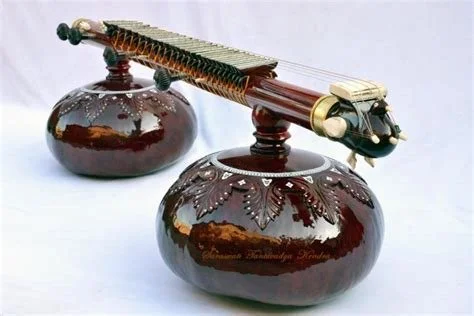
Evolution
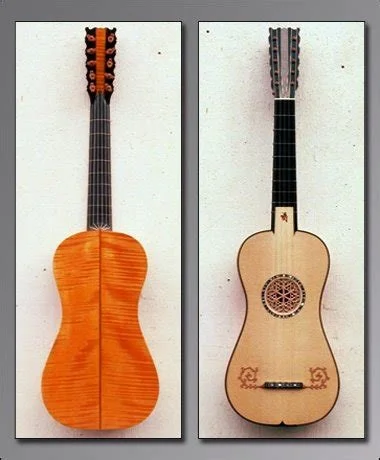

Baroque Guitar
Electric Imrat Guitar
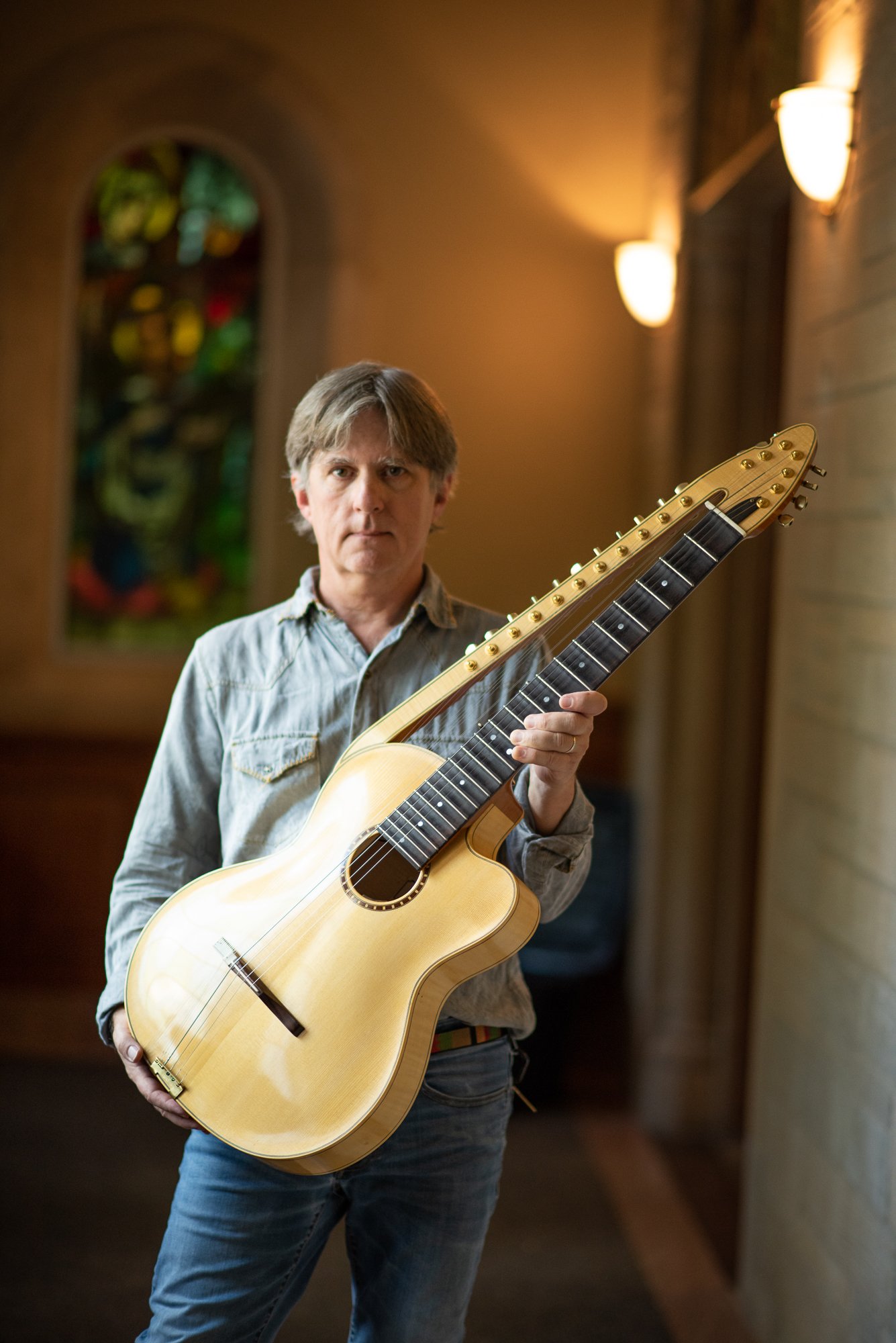
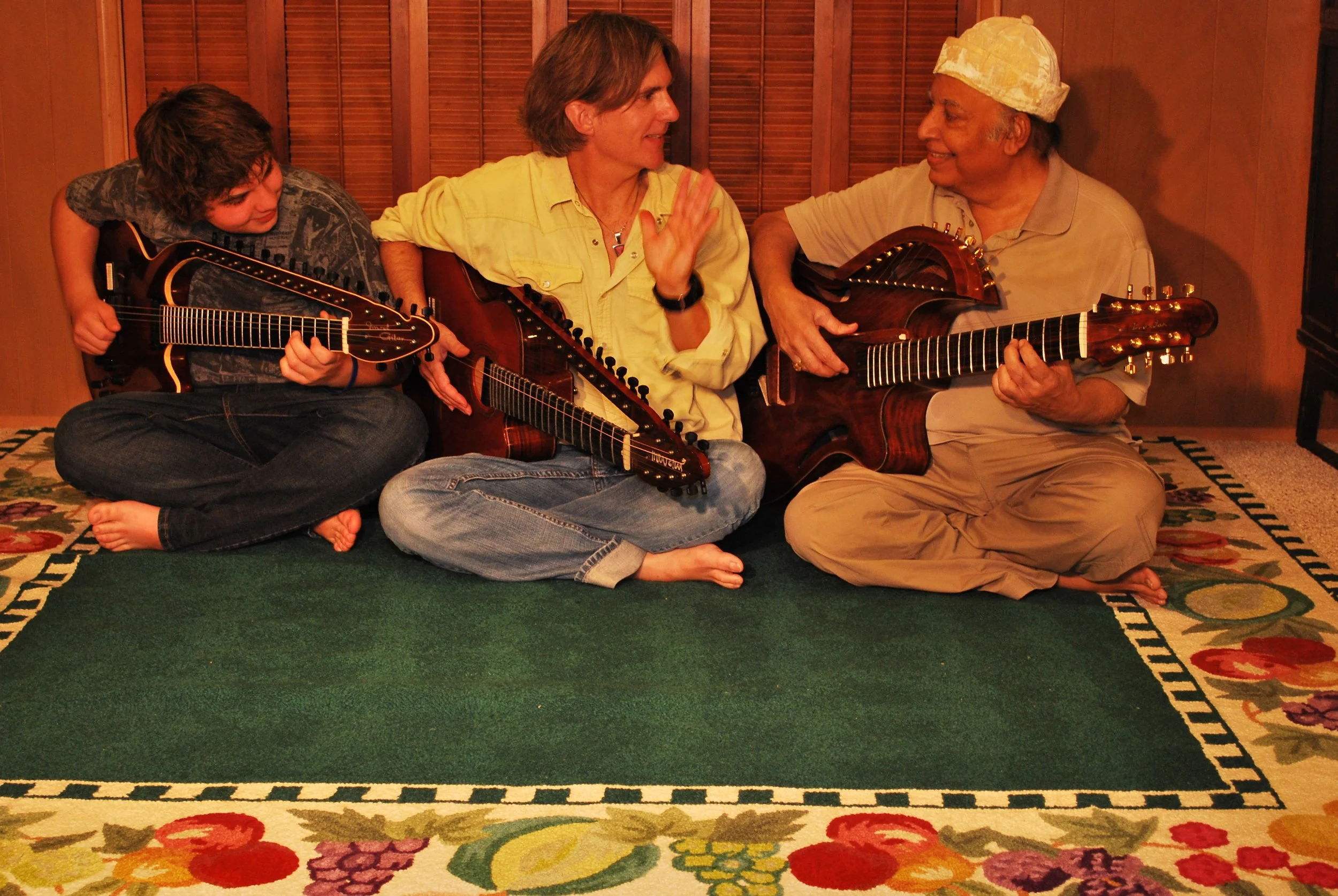
Imrat Guitar 5
Family of Imrat Guitars
Lute
Rudra Vina
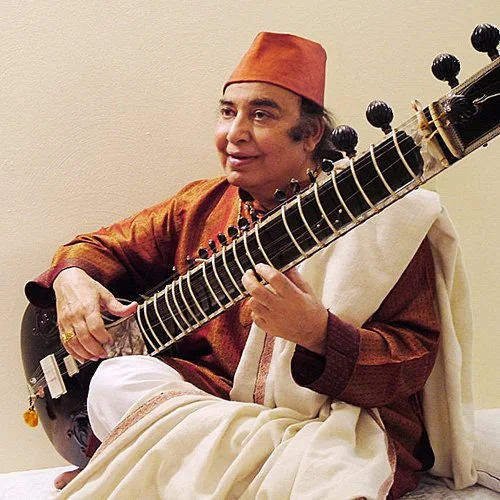
Ustadt Imrat Khan
Ustad Imrat Khan is a member of the greatest family of sitar players which stretches back several generations to the famous Muslim master musicians of the Mughal courts. His profoundly inventive control of melodic line, his highly imaginative rhythmic sense and musical wit, his virtuoso technique express every aspect of the greatest Indian classical forms, spanning the whole spectrum of their notes, nuances and feelings, from grave and meditative to light-hearted and playful, from the heroic to romantic and to devotional. Furthermore, Imrat Khan is increasingly recognized throughout the world not only for his total mastery of the sitar and surbahar, but also as one of the rare Indian masters capable of conveying the full range of India’s musical heritage, with no compromise to passing fashions.